Tuesday, 10 February 2015

10 reasons why AAP's victory is good for India

The die has been cast.

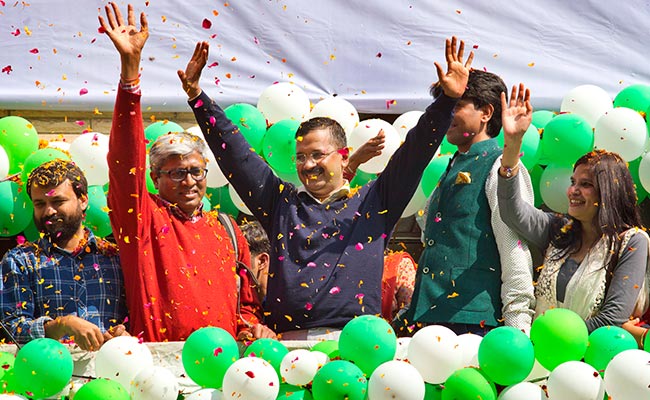
For the first time in its half-state history, Delhi has elected a government devoid of the two major national parties, that too with more than just an absolute majority (67 seats). Quite unsurprisingly, the Aam Aadmi Party has bested its only real electoral nemesis - the BJP, 'sweeping' nearly all of Delhi with its incorruptible broom.

Despite what some quarters may believe, an AAP victory can only mean good news. Here's why:


1. Delhiites finally get a government they deserve

Much confusion had prevailed over the national capital ever since the AAP's 49-day debacle. Delhi finally gets a stable government that promises to be held accountable (this time around) and will (hopefully) see out the five-year term. We deserved it.


2. A non-Cong/BJP government - good for Delhi, good for democracy 

Well, not all non-Cong/BJP governments have succeeded in delivering good governance to their states (SP in UP, TMC in West Bengal), but Arvind Kejriwal's party looks like a more rejuvenated, formidable version of January 2014 itself, with most of the ingredients needed to govern Delhi. Also, it's great for democracy.


3.Three seats short of a full house

Who likes to play tambola? AAP does for sure.

The newbie party continues to outdo itself, sometimes to the disbelief of its own leaders. The Mufflerman and his trusted aide and psephologist Yogendra Yadav had expected to land anywhere between 46-51 seats, but alas, the Harry Potters of Delhi have more than doubled their tally from the last 2013 election; with 33 out every 35 seats going to the AAP! Easily outdoes Amitbhai's heroics of 2014 when he delivered UP to the BJP.


4. Kejriwal has 5 years to govern and nowhere to run

 The AAP's manifesto was, to say the least, more refreshing than the Congress' and the BJP's vision document. The magnitude of their victory represents the trust reposed in them by the electorate. Now, Kejriwal and his team must work steadfastly to translate the umpteen election promises into reality. He has five years to show for his work and nowhere to run.

You can't run, you can't hide and you can't escape Delhi's love.


5. Modi's first real defeat in 14 years

Modi is the one name you get to hear in almost all elections nowadays, whether he's contesting or not. Every election his party partakes in becomes a referendum on his personality; if he wins, the cult gets solidified. If he loses - well most people thought he was invincible; that's the way it has been for him since 2001 when he became Gujarat Chief Minister. Never one to taste defeat, Modi has been given a bitter pill to swallow by Delhi's CM-in-waiting. No better place to halt the Modi rath than the very capital where he resides.  

Let's hope he behaves statesmanlike and comes through on his promise of cooperation in Delhi's development.


6.The volunteer > karyakarta 

This election also marks a very significant victory. That of the animated volunteer over the indefatigable karyakarta/swamsewak (which also means volunteer). The volunteer, at a disadvantage financially, graciously accepted the headstart of a few months and began to work tirelessly. The karyakarta thought he had the winds and waves with him, but without a firm mast, his ship gave up.


7. The beginning of the end of vote bank politics

Don't cast your vote. Vote your caste.
Sorry, not this time.

I believe this election was a harbinger of change in the way electioneering was carried out. For the first time, a party successfully reached out to and canvassed support from all major sections, classes of society across caste and religious lines. This was only possible through a neutral and positive agenda that catered to all discriminated against none.


8. Thumbs down for communal politics 

Communal politics simply doesn't resonate with young India anymore. While Modi swept the general election on his promise of 'Sabka saath, sabka vikas', the idea hasn't been received as expected by his ideological cohorts. The Delhi election season played out against the backdrop of religious tensions, imprudent statements by loony members of the ruling party, and an intractable air of vitriol, all of which allowed the AAP to extract maximum political dividends.


9. The election that brought some sense into the voting class

Delhi is impatient as it is pragmatic. Nowhere else is it cool to be a Modi supporter at the national level, while voting Kejriwal to power in Delhi with a near full house.

Delhi separates the 'bhakts' from the brains. Delhi forgives but doesn't forget.

As far as voting patterns are concerned, BJP has lost trust in all the 57 assembly constituencies that it won just nine months ago, some of which (like Harsh Vardhan/Bedi's Krishna Nagar) were considered impregnable. BJP's monumental debacle has come at the hands of an informed voting class that deserves credit for its intelligence.


10. Allows Congress to rebuild and BJP to return their development agenda

The only success Modi has had in this election is his dream of a Congress-mukt Bharat inching closer to realization. To deracinate the Grand Old Party from the capital is no mean feat; a complete wipeout is insuperable. Whether they can rebuild in time to save what is left of their sinking ship is a question only the Gandhis can answer.

The BJP must've been dealt a hard blow with this defeat; but they had it coming. Their electoral successes in other states turned into complacency which literally got to their head. The cadre-centric formula works everywhere else but not in Delhi. Delhi deserves better.

Sunday, 8 February 2015

Dear Pradhan Mantriji

Dear Pradhan Mantriji,
As of this writing, Delhi has voted and an encouraging 67 percent turnout has been recorded.
Regardless of what the final tally will be, the Delhi vote is overwhelmingly in favour of the Aam Aadmi Party. Whether you like it or not, the brazenness of your acolytes and the reticence of your government has caused you to cede ground in the very city that hosted you with the adulation fit for a hero.
Exactly ten months ago, the scenario had been quite different. India had been fed up with an effete UPA government and in “Modi sarkar” we trusted. On voting day, we happily dyed our indexes with violet, but our hearts were doused in saffron.
The sarkar promised us “Sabka saath, Sabka vikas”, pro-people good governance and development that would catapult us to the league of extraordinary nations. And we thought we had a hero.
We applauded you for pitching India to the East and the West, but you seemed to forget the very constituency that authorized your all-expenses paid world tour. We voted for you because of your promise to translate your vision into palpable development. Never forget that the barometer of development moves its needle only when there is real delivery and less rhetoric.
Of course, development doesn’t appear out of thin air. It takes time. When you say we need to “Make in India”, I’m with you cent per cent. When you exhort Indians across the world to give back to their motherland by “manufacturing” development, I’m listening with intent.
But all I, and millions of young Indians wish to know is - "Manufacturing” communal polarization, is this a component of your developmental agenda?
So wait, are you saying that it'll take years before we see any tangible economic development, but your hard-line cohorts are ready to stir up a riot on demand?
Dear Pradhan Mantriji,
I do believe that you aren’t always in control of those who spew venom at will. But your visible inability to rein in these minions coupled with your deafening silence on the issue casts doubts in our minds and aspersions on your image.
In the run up to Lok Sabha 2014, you spoke about India’s need to harness the potential of its youth — the largest percentage for any country in the world.
Pradhan Mantriji, it seems, by acquiescing to your party’s cultural progenitors, you have absolutely underestimated the power of young India.
We have been to the moon and back, continue to grow leaps and bounds in the fields of science, technology, and expect to be the economy of the future (only second to China). So, how exactly do you expect India’s generations X & Y; who have grown up pledging to protect the saffron, white, green and blue, to subscribe to an archaic agenda?
We are a tolerant civilization, or at least we used to be. We are “tolerant” enough to turn a blind eye to rapes and sexual harassment, but cannot swallow bitter 'roasts' (especially if they’re aimed at someone else). We don’t mind being the second largest population in the world (soon to pip China to the top spot), and yet Valentine’s Day is now a day to fear express marriages, not to celebrate love.
To cut right down to it PMji, your lack of discernment for India’s youth may cost you dear. I’m afraid the Modi-Amitbhai juggernaut would come to a halt outside Delhi’s Vidhan Sabha. It's a wake up call you better pay heed to.
Irrespective of ancestry and religion, any and every Indian has a stake in this country. Vitiating the atmosphere time and time again never really helped anyone. Except, of course the party you lead and the one you have opposed for eons.
Your party’s successes in other states might have compelled you to use the same cadre-centric formula for Delhi; except, Delhi isn’t like any other state. Kiran Bedi might be a model citizen, but by anointing her as Chief-Ministerial-hopeful, Amitbhai has clearly pushed the panic button.
In Kejriwal, I see a man I disagree with on many fronts, but have come to admire on issues that matters most. Whether you love him or hate him you cannot debate that he truly has gauged the pulse of the capital.
While you dawdled on setting a time-frame for the poll, the muffler man deftly canvassed support from all quarters, castes, communities and sections of Delhi society. By the time you joined the party (a tad too late), and decided to go gung-ho, Kejriwal had already succeeded with own “ghar waapsi”, wooing the common man into the fold.
Politicians like the ones your party continually rewards, make mistakes and get away with them. Only a common man errs, owns up and apologizes for his shortcomings. And such a common man deserves respect, despite his 49-day debacle and relative administrative inexperience.
I’m not a Bhakt, but I still subscribe to your agenda of “vikas” for all of “Bharatvarsha”; I’m willing to snub all of your naysayers, if you come through on your promises.
But for Delhi, my Delhi, the heart says “ab ki baar Kejriwal”, and to him my vote (virtual) goes. It’s a gamble we’re willing to take.

Monday, 12 May 2014

Schrodinger's Cat.


I stepped into my car;
Mr  Satan in the passenger seat,
And he said, “ I shall spare this life of yours,
Shall you be willing to take me to Hell’s Kitchen.”
Sensing the casual loop I said,
“Well as you like it ,Mr Baton.”
“And just what did you call me, Mr Dible?”
“I would prefer Incrad, sugarpie.”
It seemed as if a role reversal had taken place.
An implosion was imminent,
With Dark Angels too?
The wrath was infernal, swallowing everything in its path.
My brain wasn’t dead , they said,
And I had a choice to make.
To enter a parallel universe ,
To avoid sipping poison from the cup, like my friend, the cat
That was so perfectly placed, oh the effervescence.
Like Satan studied Feng Shui.
I evaded death in surrealism.
And even Satan succumbed to his own connivance.
I can see Einstein , Podolsky, and Rosen, gleaming with pride,
Smiling with my smile.
Thanks to Erwin Schrodinger,
I can still do that for a while.

Sunday, 11 May 2014

India 2014: Varanasi's Roadshow Rut and the Road to Delhi


For the whole of last week, it seemed India's capital had shifted some 500 miles south east to the holy town of Varanasi. Nestled on the banks of the river Ganga, Varanasi - known locally as Kashi or Banaras, has become more than a just a town linked to the spirituality it bestows upon its visitors; it has become larger than life; for on May 12 it will bear witness to the most decisive political battle in this year's Lok Sabha elections.

Lenity would force observers into believing that the fight for the Varanasi seat is a three horse race (Uttar Pradesh's ruling Samajwadi Party (SP) isn't even in the running). This is indeed music to the ears of his detractors, but they may have to concede that Bharatiya Janata Party's (BJP) PM-candidate Narendra Modi is the frontrunner to wrest the key constituency. Other claimants for Varanasi include the Aam Aadmi Party's (AAP) Arvind Kejriwal, whose short-lived stint as Chief Minister of Delhi was seen as utterly tumultuous and a betrayal of those who voted for him; and the Congress's lesser known candidate Ajay Rai, who built his chequered career as a BJP legislator before defecting to the former.

The 2014 election is touted to be 'the biggest' poll of its kind, not only because of the enormity of India's voting populace (estimated to be well over 800 million), but because come May 16, the world's largest democracy is likely to witness the proverbial and electoral decimation of the ruling Congress party.

The Congress, patronized and run by the Gandhi family for decades has had a vice-like grip on the nation's political and jugular vein. Modi, who's making his first foray into national politics, is widely expected to ride the eponymous wave of fervor and anti-incumbency and form India's next government.

Holding the Congress's last stand is the family’s diffident heir Rahul Gandhi, who has failed to sway the tide in his party's favor. When all hope was lost, he even went about influencing voters in poll booths during polling in his constituency Amethi, but was let off scot free by the Election Commission of India
(EC) even after several complaints were lodged in his name.

The EC's credibility as a neutral poll body came under fire when it rejected BJP's application for Modi to hold a rally in Varanasi's Benia Bagh, but granted his opponents including Kejriwal, Gandhi and Uttar Pradesh's Chief Minister Akhilesh Yadav permission to campaign at the same venue.

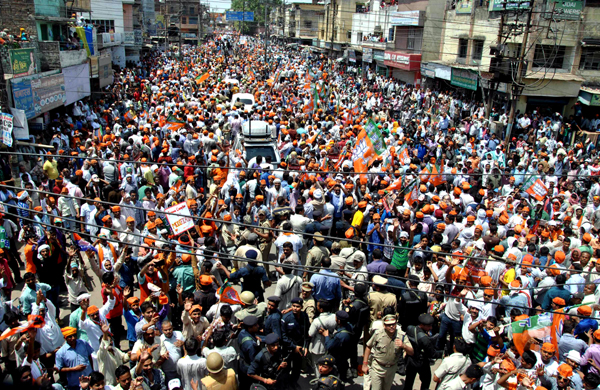
Making the most of what he could, Modi instead led a gargantuan roadshow from the Kashi's prestigious Banaras Hindu University (BHU) to the party's headquarters in the city. The three mile stretch took more than four hours to cover, as hordes of supporters and townsfolk thronged the streets to catch a rare glimpse of a man who could very well be India's next Prime Minister. Beyond doubt, Modi's procession made a greater impact than a rally ever would have. Such was its success that it forced his political rivals to stage roadshows of their own.

"If Modi comes, can Kejriwal be far behind?" asks one observer, who witnessed all the other Modi-induced rallies. Kejriwal indeed wasn't far behind. A day after Modi came and conquered Kashi, "Kejriwal was met with many supporters, but this didn't seem quite different to his protest rallies and his dharna," he adds. Only a few months ago, Kejriwal graduated from full time agitator to bit-part politician to unsettled administrator. His party has come of age a little too quickly, but it seems it hasn't quite shaken off its cantankerous side.

Only days earlier, Modi addressed a massive rally in the Gandhi’s bastion Amethi, which came as an alarm to the first family. It didn't come as much of a surprise when Gandhi returned Modi's favor, showing up with his own motorcade in Varanasi in a relatively meek show of strength. Much to the former’s dismay, not only was his Kashi rally dwarfed by Modi's, he had to deal with a rival procession a few miles away from his own – Akhilesh Yadav's. Yadav's rally had no real purpose behind it, except perhaps, to avoid a loss of face in the state he has sloppily ruled.

As has become quite fashionable this election, all three men went all guns blazing on Modi. What they didn't realize however is that, in an attempt to emulate Modi and throw dirt on him, they have actually played into his hands. Not only is Modi expected to win a majority of the Hindu vote (Hindus comprise 85% of Varanasi's population); the close contest between the other parties will ensure that the minority vote is split between the three. Modi couldn’t ask for more.

In all honesty, the Varanasi roadshow rut was unnecessary yet exuberant. For once, it did illuminate the 'City of Lights'; probably like never before, or after.


Tuesday, 6 May 2014

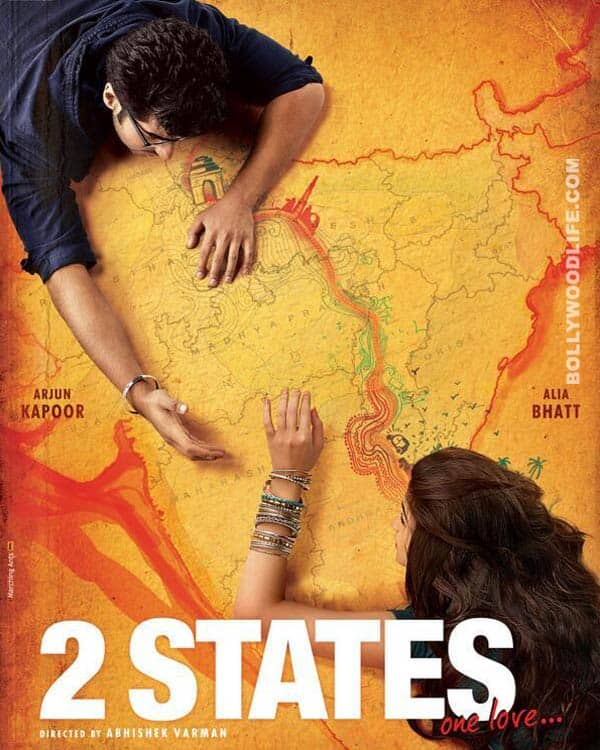
'2 States' bears testimony to India's cultural divisions


Not many books or movies successfully capture the oneness of India despite all of its diversity. Few go further and capture how divided it is despite its oneness.

Based on and named after Chetan Bhagat's book, 2 States (inspired by the real life romance between the author and his wife) does exactly that.

An appropriately vivid tale about how two contrasting India cultures are made to reconcile in the face of love, 2 States is utterly Indian in every sense of the word, evokes both pride and dismay, and will leave you yearning for more.

If you haven't read the book (I haven't), you should definitely watch the movie for the whole package - emotion, laughter, humour, and a good story to back it up. All of these you can find in Bhagat's other works (which later spawned movies of their own), and he knows how fully well how to bubble-wrap all these elements in his lucid manner.

Back to the movie. Not only did it leave me satisfied, it also gave me many things to think and talk about but perhaps the one thing that got me thinking was this:

For Delhiites and Punjabi Delhiites in particular, 2 States reinforces the idea of the typical Punjabi and the stereotype that revolves around the community. As the reel ticked on, I saw glimpses of myself, my folks, and my community as a whole. Reality bites hard for the Punjabi viewer when we are seen as an unabashedly disparate, undesirably boisterous lot (which we kinda are). Though the references are mostly correct, the film purveys the idea that Punjabi-ness is in a way, some kind of a cultural abomination to and in India.

Post-show, the more I ponder over what I saw, the more it makes me realize that maybe the Punjabi Delhiite wasn't actually inaccurately represented. Since I work in the Middle East, where several thousand Indians ship out to make a better living, the very mention of 'Delhiite' is enough to cause an unexpected flinch of the eye. A latent awkwardness that pervades the air for a second. Add to that the term 'Punjabi', and it may well be enough to give a 'Tamilian' worry lines all over his forehead.

Much to my surprise, this isn't what happens in '2 States'; at least between the lovers. A Punjabi Krish (hardly the typical Punjabi munda) and an uncharacteristically Tamilian Ananya , the two central characters played by Arjun Kapoor and Alia Bhatt respectively, find common ground in everything else - tandoori chicken, Economics and the simplest relationship between two persons - friendship. The stark difference in their backgrounds only begins to appear once they decide to get married and bring their parents into the picture.

And you guessed right: the parents simply do not get along with one another as prevailing cultural stigmas get fortified, with neither side refusing to budge.

Throw in a Punjabi wedding for good measure, and one truly begins to understand the deep chasm north Indian culture vis-a-vis the south. We are loud; they are reticent. We are overly possessive; they are indifferent. When under the influence, we are fun and yet a menace to deal with; they're perennially wonkish. All this and more brings out the incongruity of India's varied cultures.

I don't know whether this movie will draw the ire of Punjabis (or even Tamilians); whether it will encourage them to improve how they interact with other communities (better yet), or simply choose not to react to it.

I do know that while there is a minority of revisionists within the Punjabi community, most of us take pride in what we do, eat and drink. It is the way how the Punjabi simply is, and I believe a lot of it should remain as it is. Though I am among the most passive, I can speak for Punjabis, because I am one. We all need to speak up and sometimes against our folks.

Beyond a shadow of a doubt, 2 States bears testimony to India's cuItural divisions. In the India we want our children to live in, it should be absolutely acceptable for a Tamilian to marry a Punjabi, an Assamese to wed a Gujarati, or for any two Indians to whom community comes second to love.

All in all this movie is a treat to watch. Perseverance conquers all.

Monday, 24 March 2014

BJP may form India's next Government, but with Congress' support


There comes a time in the history of every great nation, when its citizens see a ray of hope out of despair; an opportunity to rewrite history, and to take the country to where it deserves to be.

For better or for worse, it is in Modi that a majority of Indians see the egress out of the era of political gloom and despondency institutionalized by a rarefied Congress-led UPA regime. His continual surge has brought him a fair share of critics and bounty hunters, who hold him culpable for orchestrating the unfortunate riots in Gujarat - a charge still unproven even after 10 years of inquests, accusations and political coercion. He has successfully warded off even his most formidable baiters, winning election after election, going from strength to strength.

From selling tea on the streets of Vadnagar to heading one of the fastest growing states in India, Modi's meteoric rise is viewed as a harbinger for positive change in India.

The 'Modi wave' is reverberating across the country. Much to the dismay of his opponents, it is very much present.

But it seems the BJP clearly isn't using this to its advantage. It is banking on the support of the Congress to win next month's Lok Sabha election.

Instead of riding the wave of anti-incumbency and propelling its home-grown candidates to win the election, the BJP has instead hired celebrities; and imported candidates from parties symbolic of graft, to secure its Mission 272+. Such electoral temerity does the saffron juggernaut no favours. In fact, it reeks of shambolism.

The very leaders that had denounced Modi as 'communal' are now singing paeans in his name. When leaders of 'secular' formations like the Congress, RJD and the JDU chose to defect to the BJP, it has little to do with ideology and everything to do with cashing in on an opportunity. Who's to say they won't do the same when the BJP is in dire straits? Candidates that shift base months prior to the election cannot be trusted to stick with the party. The late Vidya Charan Shukla was a prime example of such a flip-flopper.

The grassroot workers; who toil all year round and play an elemental role in a party's electoral performance, do not possess the same zest and motivation in ensuring the victory of rookie film star politicians and tainted ex-opponents, whom they perceive as encroachers of their political territory, foisted upon them by the party.

To the Indian voters, who have vowed to deracinate any remnants of the UPA regime, it is highly disheartening to see ex-Congressmen stand for elections wearing saffron. It is almost like voting for the wolf in sheep's clothing.

While the BJP may like to view its newfound allure as a wider acceptance of Modi's leadership, the influx of outsiders has also exposed the latent cracks within its leadership.

In a painful kerfuffle over the Barmer seat, ex-Finance and Foreign Minister Jaswant Singh, who was one of the pillars of the Atal Bihari Vajpayee-led Government, has been snubbed by the BJP for former Congress leader Colonel Sonaram Chaudhary. Singh, with his pride intact, will now contest as an Independent candidate, which may well cost the party the Barmer seat.

Not all has gone wrong. Wisdom prevailed over the BJP leadership when they decided to oust religious extremist Pramod Muthalik, within five hours of his joining the party.

This is why the BJP must ride the Modi wave, and hand out tickets to candidates who would have otherwise had little chance to win an election. It has attacked the Congress for presiding over a dark decade of corruption and misgovernance. If the defections and chicanery continue, the BJP may soon have a mini-Congress clique within its ranks.

In over a month and a half, the Indian electorate will have spoken. And we may well have a BJP-led Government with the support of the Congress.      

Saturday, 15 March 2014

Kejriwal's open threat to press freedom may be his undoing


A few weeks back the internet was flooded with articles about how the pulping of Wendy Doniger's book The Hindus was a threat to freedom of expression in India.

Most of these pieces, written by writers who claimed to be of a 'secular' disposition squarely blamed this ‘atmosphere of fear’ on the religious right, whose emergence they forewarned would stifle free speech. 

In one way or another, they presaged that a right leaning government would curb dissent to the fullest extent possible.

What is interesting to note is that these very same ‘secularists' have been sympathetic to Arvind Kejriwal and the Aam Aadmi Party since its inception. That the rise of Kejriwal and the AAP is the handiwork of the mainstream media is perhaps, a foregone conclusion.

Now, almost like an auctioneer, the former Chief Minister of Delhi claims that the media - that facilitated his rise - is in fact "sold". 

If this wasn't enough, in a comment reminiscent of the Emergency-era, he opines that "heavy amounts have been paid" to TV channels "to promote Modi".

So are we to assume that Kejriwal, who was recently exposed in a video fixing an interview broadcast with Aaj Tak's Punya Prasun Bajpai, has paid 'heavy amounts' to the channel to promote him. 

More appalling yet, was his statement that if the AAP ever comes to power, "media-wallahs" could actually be put behind bars. Isn't this what stifling of freedom of expression is? No government in India, save for Indira Gandhi's tyrannous regime, has threatened to put journalists behind bars for doing their job.

When asked whether he had made these comments, Kejriwal simply couldn't admit he had done a 'Romney'.

To understand this issue better, there are a few questions that we need to answer.

Is Indian media biased - Sure. The very fact that he is surrounded by a coterie of former journalists who are 'senior' leaders in his party - Manish Sisodia and Shazia Ilmi (formerly Zee News), Ashutosh (formerly IBN 7) and Ashish Khaitan (ex-Tehelka) prove this point.

Is the media sold? Maybe, but we don't know for sure. 

Do media-wallahs deserve to be jailed for their bias? Well, Kejriwal says so. 

The real question is - Why does Kejriwal make such accusations only against the Gujarat Chief Minister, and not members the Congress-led UPA Government at the Centre?

Well, why does Kejriwal only make accusations and more accusations? Only he knows. What we do know is that he has mastered the art of 'hit and run' politics. No to क्रन्तिकारी!

It was only a matter of time before Kejriwal took his sophomoric jibes to the next level. 

Of recent, he has tried hard to throw dirt at the BJP and its Prime-Ministerial candidate Narendra Modi. Taking repeated potshots at the Gujarat Chief Minister using unfounded statistics is part of his feeble attempt to remain relevant.

Although it is hard for him to acknowledge, Kejriwal too, has been swept by the Modi wave.

It is perhaps the first time in India's history that an opposition party hopeful of forming the next Government has been targeted as though it already is in power.

Modi has had to brave a fair share of allegations for over a decade. Not once has he intimidated journalists or the media who have gone against his writ with incarceration.

Just as the Congress perceives itself to be the voice of 'secularism', Kejriwal sees himself as the custodian of 'righteousness'. And this is where he proves to be ahead of his political progenitors - Kejriwal simply cannot deal with criticism or dissent.

Kejriwal promises he has a plan for India, and he may well have one; but we are yet to see it in full. But he isn't a protester anymore; he is a politician.

Whether he is able handle criticism with care, only time will tell. What he cannot afford to do is threaten free speech and a free media. His tomfoolery may be his undoing.


Saturday, 21 December 2013

Dhoom: 3 review: Should you really watch it?


Ordinarily, I would never do a movie review. It just isn't my thing. But for a flick with quite an alluring starcast to be this bad, I just had to write this piece.

Here goes:

SPOILERS AHEAD

There is a recurring theme in almost all movie franchises that revolve around bikes, vengeance and money: They continue to revolve bikes, vengeance and money, albeit faster, meaner, bigger.

Dhoom: 3 is more of the same storyline in a different setting. This time it's in Chicago. Abhishek Bachchan plays the same old top cop Jai Dixit with the same old sidekick Ali Akbar - whose diminutive on screen presence keeps getting more and more annoying with each passing Dhoom-oment.

Aamir plays bad guy Sahir with a poignant back story that fuels his sense of revenge towards an evil 'stone-hearted' banker corporately named Mr. Anderson. Sahir's father Iqbal Khan (played by Jackie Shroff in a cameo), mired in colossal debt to Anderson's Western Bank of Chicago, takes his own life when the latter pulls the shutter on his dream project - The Great Indian Circus.

Sahir is robber extraordinaire-cum Tony Stark by day, masquerades as a circus man by night. But like other men of his ilk, Sahir lives with a long-kept secret: a reclusive, slavish, autistic twin named Samar living in his brother's great shadow. Samar is his expedient but also his kryptonite.

Katrina Kaif plays Aliya, a freelance artist (if I may call her that) whose strip-as-you-skip dancing will leave you gasping for air. Katrina employs her signature hip-thrust with elan, and this is one of the few takeaways from Dhoom: 3.

OK, now for the real review. I'ma keep it short and sweet.

Dhoom: 3 is really just a bad mesh of Road Rash and GTA on drum and bass.

Dhoom: 3 is the reason why computer-generated imagery artists still get a paycheck. More of the same larger than life, unoriginal stunts packaged to deceive the viewer. Fail.

Too many people are wondering why Uday Chopra hasn't retired yet. Well, we should really leave that up to Aditya Chopra, coz' he's always out there for lil' bro.

I have always believed Abhishek Bachchan isn't half a bad actor as he is made out to be. But his vapid performance as Jai Dixit does nothing to prove his critics wrong.

Katrina Kaif's role adds to the sex appeal of the mean machine franchise. Besides her seemingly sensual intro number, and the gymnastic prowess with which she gyrates, she offers little to the film.

If at all Dhoom: 3 has a star, then it has got to be Aamir. Much has been said about his timeless versatility in Bollywood, where he can count only one other actor as his peer - Hrithik Roshan, who unsurprisingly played Abhishek's nemesis in the previous Dhoom instalment.

Take nothing away from Aamir - the ease with which he plays both devious Sahir and dupable Samar is a delight to watch. But then again, Aamir's performance does little to salvage a predictably boring plot.

The one thing that I did like about Dhoom: 3 is the adage Iqbal Khan recites with his sons, and which they continue to render time and again, even to their deaths.
Bande Hain Hum Uske
Hum Pe Kiska Zor
Ummedon Ke Suraj
Nikle Charon Aur
Irade Hain Fauladi
Himati Har Kadam
Apne Haathon Kismat Likhne
Aaj Chale Hain Hum

But I wonder why the Chicago Police Department would need to fly an Indian cop all the way to solve a bank robbery case. Beats my mind.

Dhoom and Dhoom: 2 may have done justice to the onomatopoeia 'Dhoom'. Dhoom: 3 fails to pack a punch.

You might laud the dance sequences, specially the acrobat-like display from Katrina and Aamir in 'Malang.' But do you need to watch the movie? No, just YouTube em'.

Well then, how bad is Dhoom?

In the first few minutes, when Jackie Shroff puts a gun to his head, and pulls the trigger, you really wish it was you instead of him.

If you are going to watch it anyway, here's something golden: Watch the first ten minutes, step out of the theatre for the next 120, and step back in. You won't regret it.

Rating - *, at best **.


P.S. - You could instead watch this - AIB's humble plea to Bollywood

Wednesday, 18 December 2013

We will bring you back home Devyani Khobragade

"There’s a great deal we hope India will contribute to. The peace and prosperity in the 21st century will be impacted upon by the outcomes of that relationship. It’s the defining partnership in the century ahead."

These words belong to United States Vice President Joe Biden, who, on a visit to India earlier this year, expounded on how his 'great' nation and our 'great' nation were both 'great partners' of the 21st century.

Great because we stand united against terrorism, unified in the face of a rising China, and as the two towering exemplars of modern democracy.  

Perhaps our 'greatest' folly has been to wholly misinterpret the American view of our testingly 'unique' partnership. Despite all the camaraderie and democratic affinity, if one tries to see through all the brouhaha - it is clear: we will never be equal partners.

Perhaps the realization of our deeply flawed and broken bilateral relationship only hit the Indian Government when a 39-year-old Indian woman Devyani Khobragade, serving as the Deputy Consul General in New York was arrested in full public view for a crime not proven in a court of law, and subject to humiliation in the form of repeated strip searches by US Marshals; unheard of for any diplomat, let alone for one who has made her country proud on several occasions.

Khobragade's alleged crime was to have denied her domestic help minimum wages as per the local wage laws, when sadly, the diplomat herself falls below the wage line. The US even went on to claim that Khobragade has made a false declaration of the maid's wages to the US authorities, thereby committing visa fraud.

Shouldn't Indians who work in US missions across India too get paid minimum wages as deemed mandatory in Washington DC?

To have her confined in a prison cell with drug addicts as inmates is not only denigratory, but is also an absolute violation of the Vienna Convention on Consular Relations.

This also exposes the deep gulf that exists between how India sees the US and how the US sees the world. This isn't just about the US playing big brother, it is about human rights; rights that the US has very conveniently toyed with over and over again.

Quite surprisingly, the Indian Government sent out stern messages to America, warning them of swift reciprocity in equal measure if corrective action wasn't taken soon and vowing to bring Khobragade back.

Reciprocity was swift indeed. Barricades were removed, IDs reviewed, Congressional delegation shunned; and US diplomats, who once enjoyed special privileges by India were now treated as ordinary diplomats. Whether or not the message went across resoundingly, the American mission
was brought to its proverbial knees.

Devyani Khobragade is a proud woman who wears the tricolour on her sleeve and we shall bring her home, even if it means further rupturing our 'great' albeit brittle relationship with the US.

She has been transferred to the UN permanent mission in New York, which means she will be able to exercise full diplomatic immunity. Soon, she will be home.

But we need to watch out for the future. If US doesn't mend its ways, it will indeed lose a 'great' partner in India.

Sunday, 1 December 2013

Paul Walker's tragic demise and life's most valuable lesson

In what was a horrible loss to humanity, one of my favourites, and one of the few Hollywood personalities who made driving a supercar look good, Paul Walker - all of 40 - died on Saturday, in a nightmarish accident.

Both Walker and his friend, who was also the driver, were immediately declared dead as their Porsche crashed against a light pole and a tree, instantly going up in flames.

Walker was loved around the world for his role in the Fast movie franchise as Brian O'Conner, a good LA cop-gone-bad-gone-good, his love of fast cars both for real and in reel.

In five of the six movies that he starred in the Fast franchise, Walker's character was in sublime control of his destiny, evading death time and again like a ferret, rising from the flames like a phoenix, stronger, 'faster' each time.

It is perhaps tragically ironic that Paul met his premature end in such horrific fashion. But his death serves a glaring reminder of why one must value life more than anything else. Speed can kill.

Three years ago on a wintry night, I came out alive and walking straight from a car crash of F&F proportions. Traumatised but not shaken, I jumped out of my car a wiser man. For better or for worse, the incident impacted me in a way I can never fully describe.

Dazed by a car blazing past me - the driver clearly under the influence - I hastily steered my vehicle to the extreme right. An impetuous lapse of judgement: to date, this has been my closest shave with death.

My car grinded against the divider uncontrollably; I could see the sparks emanate from the side like fireflies-on-steroids. All of this was filmic, straight out of the director's playbook; up till now I had only seen it in movies like F&F, now I witnessing it firsthand.

I was petrified to say the least, but I tried to regain my senses all in the moment, and fearing any bodily damage, swiftly covered my head in my arms.

The car kissed the pavement for over a hundred metres before grinding to a halt and eventually tipping over. It was a total wreck, gave many a sleepless night to my incredulous family.

As luck would have it, I had lowered both my windows while driving, which helped me get out without much effort. I escaped through one of the openings with so much as an abrasion to my side, but the incident did leave its mark.

From that day onwards, I fully began to comprehend how important life really is. I began to realize how important it is to love, to express gratitude, and to seek forgiveness.

As I recount the incident, I hope that even the bitterest of my enemies never finds himself in such a terrifying grey zone, between life and death.

Life's most valuable lesson: Value life.

Thursday, 14 July 2011

Hands Held High for Mumbai

It’s high time we realize we do not need a bomb blast to tell us our city is on high alert. Isn’t the whole world always on high alert. It’s been a decade of militancy, and really, we’ve got to introspect, are we really scared of death? Or are we selfish in being grateful, that we weren’t one of the many persons to have lost their ,lives. With time, many of us would even forget such a dastardly act of cowardice, but we have to understand that death does not have to come through a bomb blast, it can reach you through the most inexplicably subtle of ways, before you have time to react.
In this state of paranoia, we must obliterate every feeling of racial prejudice, any inhibition against ethnicity or religion from our mental curriculum, and stand with solidarity in the face of these heinous acts of terrorism. It is a difficult time for Mumbai, specially for grieving families who have lost loved ones, but calamities such as this give rise to fear and hatred; terrorists thrive on such realities, corroding our minds with scars that seldom heal, invariably making terrorists out of the timid.
It is time we put aside our cultural differences, transcend barriers of creed, and show these scumbags that unity in belief can create soldiers out of simpletons. Love and peace are only options, and we must pledge to build a solidified nation, common in perception, free from dissension, full of inspiration.
Starting from today, promise to put rudeness aside, put brotherhood in your stride, and eliminate hatred far and wide. 

Thursday, 7 July 2011

Will you smell like a bunch of roses?

Will you smell like a bunch of roses, or whatever my favourite flowers were, I seem to forget. All this, when my nose is blocked and don’t want to use my olfactory receptors?
Or will you sleep like the mellow sunflower, waiting for another day to descend upon it , erasing the light of yesterday?
Will you be the never ending melody of a clarinet, waged in triumph of love over evil, of hope in despair, of laughter in pain, of joy in loss, and so that two souls may unite?
Or will you be buried so deep in melancholic suicide that even the deepest of excavations fail in tracing the symphony that once became the sound of music?
Will you be the broad daylight I wish to receive, every time the heavens flash into my eyes?
Or will you glisten only in solitude, when I’m not there, and so aren’t you?
Will you ever be the reason that I breathe into the skies, float on fresh grass, the dew kisses my lips, and the froth of the seas is effervescent and sprays its foam on my desiccated face?
Or will you be my sole reason of contempt, my mission of malevolence, and the cause I despise everything nature and society has to offer.


Read from the beginning and alternate between stanzas and you will see life is beautiful.
Read from the second stanza and alternate likewise and you will see how pathetic you’ve made life for yourself.
May you never read the second stanza. Never begin with Or.

Sunday, 19 June 2011

A Gay Girl in Damascus and the Arab Spring Conundrum


Nearly four decades of the Assad regime, first the father and then the son (incumbent), have etched memories of economic stagnation and underdevelopment that would be nothing but difficult to obliterate. Given the current situation in the Arabian Gulf and the Maghreb region of North Africa, it is immutable that nothing has brought about more unity in the Arab cultural identity than this critical insurrection against a tyrannical regime that has reigned with an iron fist.

The Arab Spring revolution, also known across the world as the Jasmine Revolution, sprung with an indefatigable resolve to overthrow corrupt and authoritarian regimes, mainly regarding the stagnant social and economic status of the vast majority of Arabs. Realizing that governance with little or no freedom is derogatory to the idea of a democracy, 2011 has been the year of rebellion across the Arabic speaking world.

Enter Amina Abdallah Arraf Al-Omari, an American-Syrian blogger, who claims to be gay, representing the gay and lesbian majority of the country. In epic narratives that brought to light the ignominy of the Syrian LGBT community, as well as her own, A Gay Girl in Damascus garnered widespread attention not only in Syria, but across the world. Her Facebook page already had one and a half thousand fans before it was detected that the blog was a hoax, created by Tom McMaster, an American, who allegedly claims that the identity of the individual was contrived, but the details were veritable. The blog raised serious questions about the treatment of homosexual people in Syria and their maltreatment. Not only this, it emboldened the exasperated citizens to voice their opinion on the Internet.

As if tribulations for the people continue, so do the death tolls rise, and Syria continues to hurtle down to the precipice. The Shabbiha ( Pro-Assad gunmen) , as they are known, have  killed more than two thousand civilians already. They have tightened up security across all borders and have eliminated any chance of escape, save for a couple border openings in Jisr-al-Shugour with Turkey. Most Syrians, left without an egress out of this political hullabaloo, look towards the West to salvage any hope of freedom. However, they aren’t enamoured with the fact that beseeching the West for an intervention would only ruin their democratic propaganda. Orthodox Syrians firmly believe in an old proverb which goes – The ziwan (rye grass) of your own country is better than the wheat of the stranger.

Imploring the West causes more harm than good, not to one but to both the belligerents. For the Western powers, another failed attempt at pacifying tensions, replicating that in Morocco, could be grave to its aspirations of regional alliances. Syria, and the rest of the Arab world, faces far more predicaments than the former. Firstly, sharing borders with Israel would only escalate tensions in a highly volatile region with flaring levels of animosity. Secondly, if the Syrians were to depend on the West, they would face extensive condemnation from countries such as Libya and Yemen that have avoided any confrontation with them. Furthermore, any involvement in Syria’s movement could only exacerbate the oppression of the Assad regime. Also, the West connotes with the idea that the Syrian’s would believe Israel to have an upper hand in all of this.
The question is- Till when will the UN turn a blind eye to these abhorrent wrongdoings in Syria and the Middle East? More importantly, when will the revolutions across the region set the harbinger for democracy and stability?
Food for thought.

Saturday, 11 June 2011

An IQ analysis of the fairer sex

Irene AdlerImage via Wikipedia
Perhaps the best aphrodisiac to ever fuel the carnal mitochondria present in the DNA of mankind is a concoction of pure seduction and sheer dominance. Be it Catherine Tremell in Basic Instinct , or Irene Adler in the Adventure of Sherlock Holmes, each woman has entrenched oneself in a position of power , so much so that they can be fairly described as the epitome of femme fatale. To able to see beyond the vestiges of human thought, ahead of human intelligence is what higher Intelligence Quotient (IQ) is all about. The ability to hoodwink,  tantalize and outwit the physically dominant sex with just a promising smirk , can rightly be included in an analysis for measuring intelligence.
Long gone is the Dumb Blonde stereotype, and it is safe to speculate that the fairer sex has found their way in almost every pair of trousers with profound ease- Yes, even blondes. However , it isn’t always that the success of womankind is devoid of platonic elements in society. This claim is ordinarily justified in the Indian aspect as well. Every year for most of the decade, girls surpass boys with a higher percentage score in the Board Examinations. If IQ was solely based on literary intelligence, the paucity of women in social influence wouldn’t have been a reality. However , speculation  is just an approximation.
Not every scenario is the same, and the balance of power has seemed to shift in favour of the modern  woman. The music industry , at a glance, has had a paradigm shift from the Beatles to the Michael Jacksons of the yesteryears ,to the Lady Gagas of today. Any indoctrination of the idea that stupidity is inherent in nature, is reinforced by the song lyrics which say – “ You’re on the right track baby, you were Born This Way”( Yes, this one’s for you blondies).The cultural incursion of the neo-feminist, much to the dismay of the disparaged man, has brought out the effeminate side of imbecile males ( See Justin Beiber). To add insult to injury, the Twilight series has tarnished any hope of a Thousand Splendid Suns of wisdom. Such an outbreak of emotional introspection has only been rivalled in recent times by the E. Coli outbreak in European cucumbers. Not to take away credit from a suave, confident woman, the social typecast of an equal womankind is more desired than accepted.
They say, to spread the word , you have to tell a woman. The day isn’t far when  IQ  connotes more than just Intelligence Quotient, instead it is interpreted differently by different sexes. For the woman- I Quote, and for the destitute male- I Quit.

Enhanced by Zemanta

Saturday, 4 June 2011

Environment in requirement

Devils Punchbowl Waterfall at Arthurs Pass in ...Image via Wikipedia
Ever wonder what a drop of petrol, a homeless bird, and a withering forest have in common? They can be saved. The environment around us is an entity on its own, and yet it is intrinsic to our very existence. It takes one to change the world, and indeed one single, yet magnanimous effort can make a difference.
Ecology or the study of environmental science transcends the boundaries of local habitation. It encompasses much more than just an area or a precinct. Ecological research has shown that changes in environment across one region undeniably affect the other.
When one thinks of the environment, few of the following words come to mind – sustainable, recycle, afforestation, animal slaughter, industrial emissions etc. The questions they pose are nothing short of rhetorical. Should we not plant more trees? Should we not consume less meat? Should we not switch to Hybrid cars? Should we not use energy efficient bulbs?
Well, finding an answer to any of these questions appears to be, well basically, a no-brainer, but it appears deludingly disparaging. To elucidate further, a recent survey attacked animal rights activists who condemned the killing of seals and whales in the Arctic and Japan respectively.
This leads us to two questions- Is the killing done for game or for consumer purposes? There is no doubt that these two regions consume the most amounts of seals and whales respectively. If there ever was a reason for global warming that appeared inconclusive prima facie, it has to be the seals and whales conundrum.
Seals the world over are known for their warm bodies that melt the ice surface with time. The continuous growth in population of whales across the world has led to rising sea levels. How? – A very important postulate of Physics comes into play here- Archimedes Principle. Just like an average human tends to displace water when they lay in a bath tub fully brimmed, rising number of whales in the seas does the same.
Is it affecting our environment positively, or negatively? Got to give something, something’s got to give. The justification of human deed comes with individualism. What can one person create, that is both awe inspiring, pluralistic, and durable, for the whole world to implement? Initiatives such as the Earth Hour and Live Eight Concerts across the globe only uphold the promise of a better day, but not guilt free tomorrow. Why can’t every single day be celebrated as Environment Day? Why do we ensure we behave our eco-friendly best only the fifth day of June, and not every single day we live henceforth.
Personal merit notwithstanding, the perils of entertaining a global village has debilitated our ecological progress in the name of advancement. Waste material, that was earlier limited to garbage, is now radioactive; petroleum and forest, that are perishable commodities, are compromised. Is it fair to use paper bags to prevent usage of plastic?
It is the hypocritical nature of Homo sapiens, to first rebuke the mismanagement of a  crumbling environment, and to add insult to injury, be the very perpetrators of the human cul-de-sac. It is abject poverty not in our pockets, but in our minds not to able to cherish the beauty of the environment. Only if our busy life hadn’t let us spin in pirouettes like we are today, the promise of environmental longevity would be etched on the seal of human civilization.


Enhanced by Zemanta